After a long time away, there is nothing like coming home, sleeping in your own bed and nesting in your own space. A few days back here on the southcoast of New England and we have been treated to a full range of March weather- balmy days that had me out cleaning garden beds to “alleged blizzards” that did not deter these determined little crocuses. As I got close enough to focus I felt like I could hear them pushing the snow away and saying, “I think I can, I think I can…..
Tidbits from the Ride Home
During this journey - down South, out West and back again, we have been in many Visitor Centers. While the staff have always been well-informed boosters for their home states, Oklahoma wins First Place for the classiest highway visitor center anywhere. Just over the Texas border, Oklahoma greets visitors with a beautiful stone building complete with comfy leather chairs, fresh coffee, lovely, well-organized handmade wooden literature racks and exhibit-quality photographs highlighting the state’s best places to visit. The restroom is worthy of a 4 star hotel. Our sorry New England roadside visitor centers could learn a thing or two….
Texas Forever
On this journey we have driven through east Texas, west Texas and the Panhandle. It was a lot of miles in the Lone Star state. More than once the phrase Texas Forever, started running through my mind. I first heard it while watching 5 seasons of “Friday Night Lights.” In the show it is a phrase meaning friendship, living large, and a love of Texas. In my car it was a mantra about endless wind and dust. As we sped past this “bug ranch” I took a quick shot with my iphone and decided that Texas Forever would give me a lot time to practice focusing and composing in a moving vehicle.
The Bug Ranch
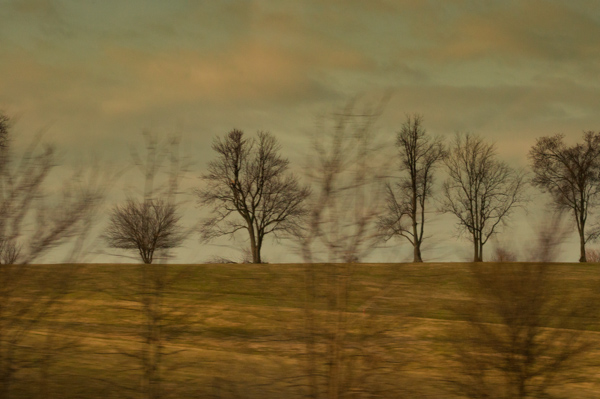
There is a type of photographic imagery created by intentional camera movement or ICM. When done well, the result is a dreamy, impressionistic, painterly and often abstract image. During the learning curve there are a lot of blurry candidates that go directly to the trash.
Oklahoma Trees
The Lone Tree of Arkansas
Yelp and TripAdvisor may have replaced paper guidebooks, but it was our experience that they are both pretty much useless when it comes to small town America. The mom and pop places that supposedly have good "down home cookin" were often non-existent or had been replaced by Taco Bell's and Tire Stores. Happily in White House, Tennessee, population 10,587, we found that the latest iteration of Tanya's Cafe, was a little piece of Guadalajara, De La Paz Mexican Restaurant. The food was yummy.
The colors of Mexico in the hills outside Nashville, TN
In general, motel staff gave us good recommendations for local places, except for Lexington, KY where instead we ended up in front of the best sign of our entire trip.
But it didn't take long for our dinner prayers to be answered. A few door down the Thoroughbred Cafe, a neighborhood joint, served up Kentucky-style barbequed brisket and Kentucky Ale while these guys watched over us. Almost home....
Signs of Spring
Snow one day, blossoms over adobe walls the next morning...Spring in Santa Fe.....
New Mexicans and Eclairs.....
My grandmother was a woman ahead of her time. While most women of her generation were homemakers, circumstances forced my grandma Ida into the role of working mom. She ran a restaurant and then went to work at a hostess a “white tablecloth” place that was spiffy in its day. She worked hard and made sure that her girls had what they needed. This did not, however, include much in the way of home cooking. On the many nights when my grandmother worked late, my mom and her sisters ate warm dinners from the restaurant kitchen that Ida had delivered in a taxi.
So you get the picture - no "Grandma's home-baked cookies" for me. But Ida did something far better. Throughout my childhood she never appeared at our house without a pink pastry box holding éclairs or cream puffs from the local bakery. This was the Fifties when bakeries actually made recipes from scratch using real butter and cream. My love affair with baking began with those pink pastry boxes. There is nothing like being a kid with a small face and a relatively large cream puff. When you bite into it, there are gobs of cream squirting all over – waiting to be licked off with a joyfulness that I can still remember. Over time, I switched allegiance to the chocolate and pastry cream of those éclairs…..
What does all this have to do with Santa Fe? Well, it turns out New Mexicans have a thing about éclairs. We were standing in line waiting to order in a café one day when a waiter walked by with the biggest éclair I had ever seen. On his next pass I just had to ask, and he laughed saying, “I took one of these giant éclairs home and it took me four weeks to eat it!” Several other places in town feature big éclairs.
Giant eclairs of Santa Fe are far bigger than iPhones.
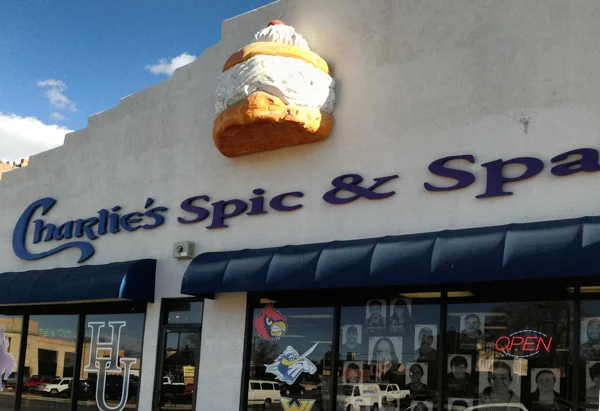
But nothing prepared me for the extra giant humungous eclairs we found in Charlie’s Spic and Span coffee shop in Las Vegas, NM. The giant cream puff above the door should have been a dead giveaway.
Cruising the pastry case I stopped dead in my tracks. If Santa Fe had a Giant Éclair, - Charlie’s makes extra giant humungous size éclairs – at least 10” long. All are made on the premises with great pride.
I didn't have the presence of mind when I snapped this photo to ask if the guy behind the counter was related to the painting behind him. Next time I need 40,000 calories I will drive back and ask....
Galisteo Basin Preserve
Galisteo Basin Preserve is a 13,550 acre "Stewardship Community" just south of Santa Fe. It includes trails, open space and several planned communities. The views go for 100's miles in almost every direction.
Best seat in the house, found somewhere along Cook's Loop.
Another Day in Santa Fe
Yesterday's cold front blew through, bringing hail and gorgeous light. Good thing we had finished our hike in the Galisteo Basin and were in the car when it started. Have I mentioned how much I love my iPhone? Took this picture from a moving car.
Back to the Future
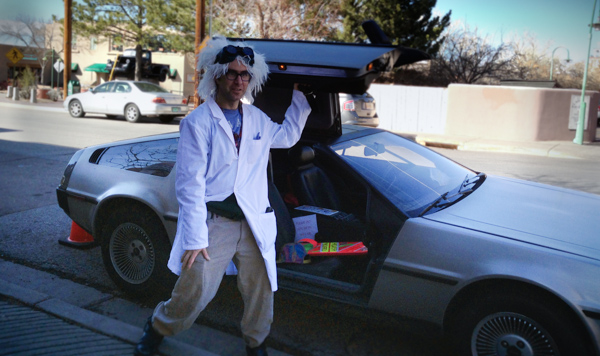
Walking home from the bookstore the other day we encountered the crazed professor and his Back to the Future car. George Martin, author of the Game of Thrones, bought the Jean Coctaeu Cinema where he shows whatever he wants -- from highlights of Polish cinema to Barbarella. Back to the Future was the movie of the day.
MAD-rid
About 40 minutes south of Santa Fe are the oldest known mines in the US. Turquoise from the Cerrillos Hills has been found in artifacts dating back to 900 AD. Native American pottery glazes from the 1300's contain lead from this region. There was a flurry of mining activity for gold, silver, lead, coal and turquoise between 1880 and the turn of the century, but it did not last long.
Funky mining shack
In the mid sixties one of these old mining towns, Madrid (pronounced MADrid, emphasis on the first syllable) got a new lease on life when the owner of the town starting renting the broken-down shacks to bikers and artists for next to nothing. Over the years it shifted from being a hippie town of pot dealers and bikers into a vibrant, if quirky, artist community famous for its July 4th parade.
Typical Madrid shop
Walking down Madrid’s one street you find galleries, bikers, “new-age” oldsters, and families enjoying ice cream cones.
Out for a spin in Madrid
The most interesting artwork in Madrid was that of stone artist, Joshua Gannon. He is still mining the hills, gathering granite that he fashions into handsome and truly unique fountains.
Taos Pueblo
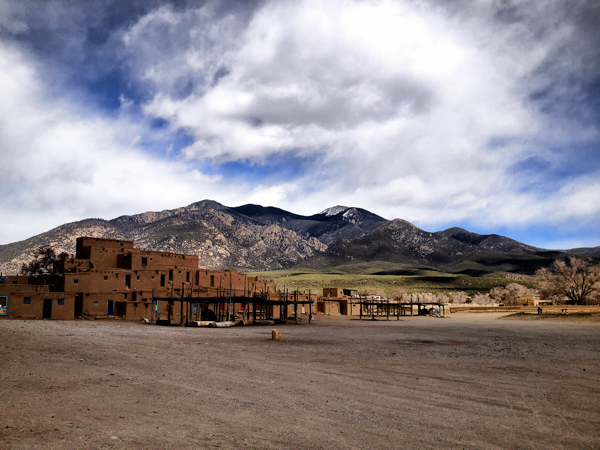
Throughout the Southwest there are thousands of archeological sites with the remains of lost and abandoned homes. Often whole communities moved or died because of lack of water. The Taos Pueblo is the exception. It has been continuously occupied for over a thousand years. Why? Location, location, location. This pueblo is nestled up against the Taos Mountains. Pueblo Peak at 12,305 not only provides a dramatic backdrop to the community, but a steady source of water for the people, animals and crops.
photo by David Ehrens
Rio Pueblo starts at Blue Lake in the Taos Mountains, runs through the Taos Pueblo and then into the Rio Grande. The log drying racks in front of the pueblo are used for drying corn and other crops.
Kiva oven is still used
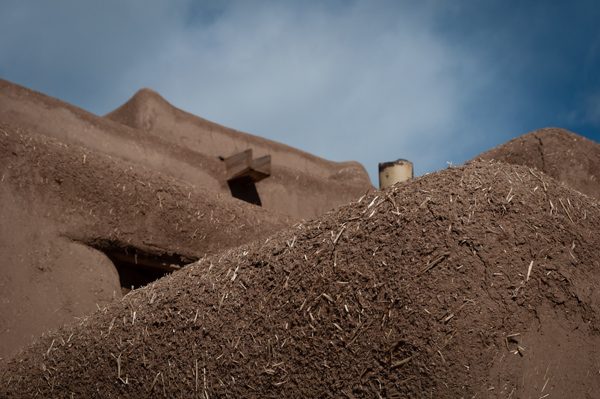
Adobe showing a bit of age
As if sent by Central Casting, these free roaming ponies came galloping by for a drink just as we crossed the bridge over the river.
Quirky Albuquerque
Albuquerque is a big sprawling high desert city that runs right up the side of Sandia Mountain. Central Avenue, the main east/west thoroughfare, has seen the city’s good times and the bad. Currently, it is experiencing a bit of a renewal as an arts and entertainment district that began with the restoration of the KiMo Theater, a unique example of Art Deco-Pueblo Revival Style Architecture. It was quite eye-catching in the late afternoon sun.
Just down the street was the Library Bar and Grill.
Driving by at 30 miles per hour doesn’t give you enough time to enjoy the titles..
Sometimes you are just lucky when you pick a seat at the counter in a diner. Right next to the milkshake machine at Lindy's Diner is this faucet from nowhere sculpture - just sitting on the counter next to mixing bowls.
The waitress told us with a laugh that when the drunks come in they are truly flummoxed. There is real water running from the faucet, courtesy of a small aquarium pump and a clear plastic tube in the middle. Quirky…..
While all these quirky eye-candy images were fun, the stunner of visit to Central Avenue was an exhibit at the Robert Levy Gallery. On display were images from Gordon Park’s journey through the South to document segregation for LIFE magazine. These photos were recently found and were not part of the original 1956 LIFE photo essay entitled Restraints: Open and Hidden. These are not the black and white images of brutal conflict that many of us associate with the fifties and sixties, but rather color images of everyday life in segregated Alabama and Mississippi.
Friendly Grafitti
Here in Santa Fe not only do drivers back up to allow you a safe crossing zone, but the grafitti has a friendly tone.
Electric box in front of a lawyer's office on Paseo de Peralta, a main thoroughfare.
Baskets - Form and Function
Last week my friend took us on a tour of the contemporary art galleries in Santa Fe's Railyard District. This area was formerly the blighted remains of the Atchison-Topeka and Santa Fe railroad yards. After years of planning and community input a plan was created in 2000 to breathe new life into this neighborhood. Today, the Railyard is a vibrant and lively neighborhood of parks, open space, art galleries, retail, and public service buildings that honor the railroad's industrial past.
One of our first gallery stops was the TAI Gallery where works by Japanese bamboo artists were on display. While some looked like baskets one could possibly use but wouldn't dare, other creations were strictly sculptures made from traditional bamboo basket-making materials.
The following Saturday I wandered through the Railyard again, this time stopping in the Fleamarket and the Artisan's Market where I met Ericka Eckerstrand, a totally different kind of basket-maker. Eckerstrand has created a whole line of bags, baskets, and home accessories using vinyl outdoor fabric. Her sturdy, flexible and waterproof baskets are artful and extremely functional. The inspiration came to her while working in a shop that makes custom awnings. As someone who has spent hours wandering the aisles of hardware stores looking for non-traditional uses of materials - sheetrock lathing for bird armatures, for example - her creativity just tickles my fancy. Not to mention the fact that her baskets are far more affordable than the lovely Japanese ones above.
Take a look and click on the pictures to visit Eckerstrand's website.
Sleeves
Swatches of vinyl fabrics
West Texas to Santa Fe
Driving through West Texas is a journey through a forlorn landscape of energy fields - oil, natural gas and fracking. Pecos, Texas, one of the few outposts of civilization for the energy workers, appears to have more pick-up trucks per capita than anywhere else in the world. One of thing about these guys and their trucks - they are the ones you want to follow to lunch. They led us to the best brisket sandwiches ever in a little BBQ joint in Pecos.
It was interesting that when we crossed the border from Texas into Mexico the land changed-not dramatically, but reminiscent of the difference you feel when you cross the Connecticut River from New Hampshire into Vermont. Still wide open high brush country with dramatic skies - but somehow a little less forlorn, more tinges of green and yellow in the palette.
In all of stops along the way, the only place where it took us three tries to get a motel room was Roswell, New Mexico. We happened to be into town when there was a big demonstration of new Boeing planes going on, along with a conference.
Despite its reputation for UFO's, which they capitalize on, the city has two wonderful museums. The Anderson Museum of Contemporary Art and the Roswell Museum & Art Center. The latter houses the workshop of Robert Goddard, the father of American rocketry. Goddard fired off his first rockets at Worcester Polytech while he was still a physics student, but he moved to Roswell in the 1930's for the wide open space. The residents of Worcester were grateful. The museum also houses a lovely art collection.
Fraulein Bosch had a sluggish morning in Roswell. We wondered if she had been communing with extraterrestrial GPS units or perhaps was just a bit hungover. Happily she recovered once we left Roswell and got us here to Santa Fe. With its many one way streets, her services are still needed, but Fraulein Bosch's pronunciation of the many Spanish names is a terrible assault on the language. Even my gringa ears cringe at her interpretations of:
Buena Vista- BOOON a VeesTAH
Camino Lejp - CammiNO Lee Joe
Our first week here was one of atypical grey and cold, but the sun has returned. At dusk our adobe-lined street has a silver glow from the naked trees that turn from a dull brown to a silvery glow in those magic moments. The fast moving grey clouds heighten the drama.
Naked tree are lit with a silver glow at sunset
You know you are in Texas when you see this!
Land of the Longhorn
I was really glad that this truck was nowhere near me when we drove out of Austin on an icy morning. There were guys throwing sand onto closed highway ramps with shovels, and too many accidents to count.
Tidbits of Texas history
Growing up in New England and living a distinctly bi-coastal life I admit I had no real experience of chicken fried steak – only notions of something horribly fried and greasy. In Fredericksburg, Texas I learned that chicken fried steak is the direct descendent of wiener schnitzel, a favorite of the German immigrants who came to Texas in the 1840’s. Traditional wiener schnitzel is made with tenderized veal which is breaded and fried. Chicken fried steak is beef that is breaded and fried using the oil from fried chicken. Now I know and so do you...
The other really interesting fact about Fredicksburg, TX, a small town 80 miles west of Austin, is that in 1847 the the leadership of this early settlement successfully negotiated the only unbroken treaty with Native Americans. In order to meet the terms of the land grant given to German settlers around Fredericksburg they needed access to Comanche land. Eschewing the typical violent approach to Indians, this John Meusebach, had his men empty their guns before approaching the Comanches. It worked and over several days the Comanche chiefs and Meusebach hammered out an agreement. According to the Texas State Historical Society the agreement "allowed settlers to go unharmed into Indian territory and the Indians to go to the white settlements; promised mutual reports on wrongdoing; and provided for survey of lands in the San Saba area with a payment of at least $1,000 to the Indians. The treaty opened more than 3 million acres of land to settlement.” It is the only treaty ever negotiated directly between settlers and Native Americans and it was never broken.